Zanshin Calendar
Tibetan and Japanese lunar calendars with their almanac readings, offline
| Repo: | F-Droid Main |
| AppID: | io.github.iverlein.zanshin |
| Author: | Iverlein |
| License: | MPL-2.0 |
| Donation: | Webpage |
| InRepoSince: | 2026-10-02 |
| LastRepoUpdate: | 2026-10-05 |
| LastAppUpdate: | Unknown |
| LastVersion: | 1.1 |
| Categories: | Calendar & Agenda |
| Google Play: | Check if it's there |
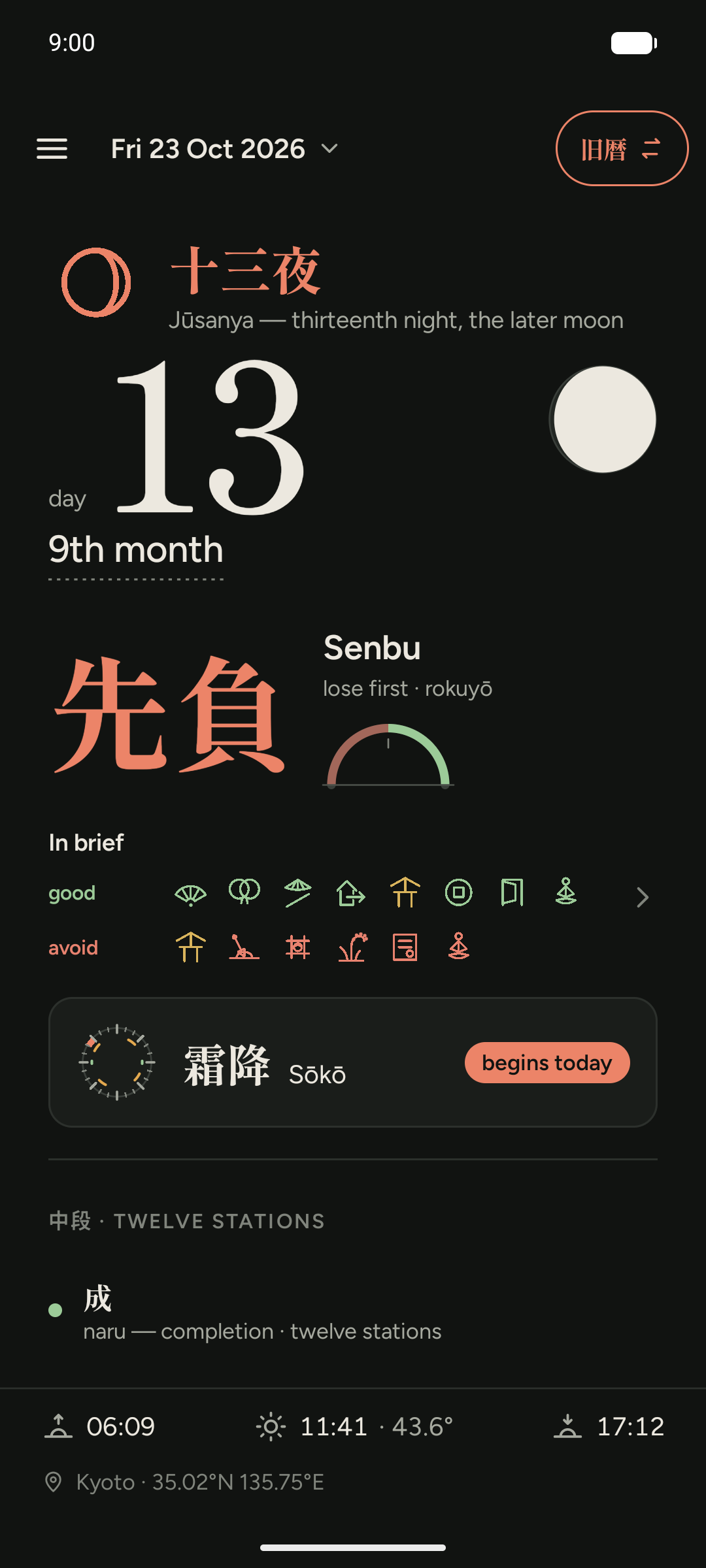
 Zanshin Calendar shows one day at a time in the Tibetan calendar or in the old Japanese calendar (旧暦), with the almanac readings that belong to that day, and sunrise, solar noon and sunset for your place.
Tibetan calendar (Phugpa)
- Lunar day, month and year, with skipped and doubled days and leap months
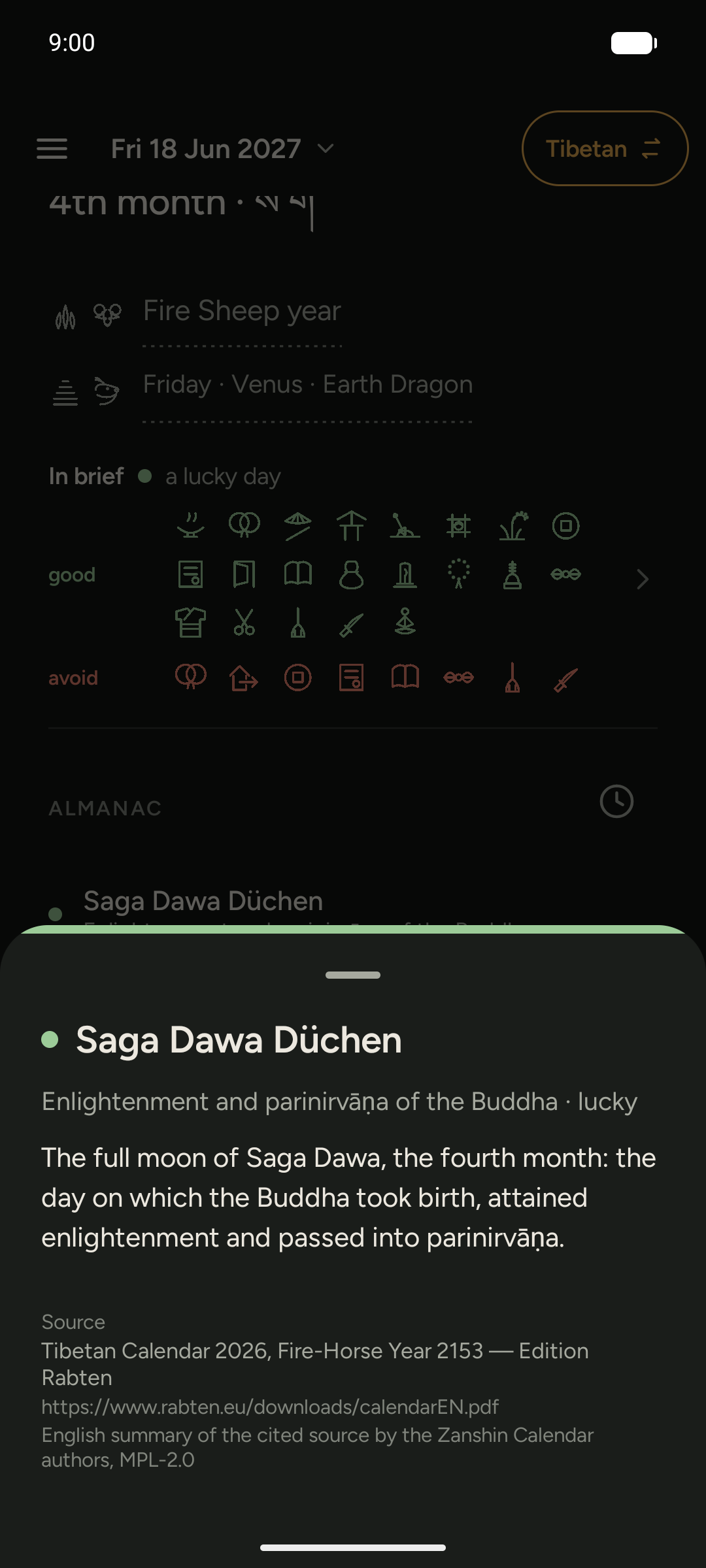
- Festivals: Losar, Chötrul Düchen, Saga Dawa Düchen, Chökhor Düchen, Lhabab Düchen and others
- Monthly observances on the 8th, 10th, 15th, 25th and 30th
- Lunar mansion, yoga and karaṇa, the element pair of weekday and mansion, the lunar-day animal, trigram and number
- The lunar mansion's nature, and a day in brief: what the activity lists name good or to avoid for the day's weekday, date, mansion, animal and trigram
- Good and bad days for cutting hair, and personal days for your birth year
- The four aspects of the year (vitality, body, destiny, luck) and, for your birth year, the white and black pebbles of the year, month, day and each hour, on a round dial of the hours
Old Japanese calendar (旧暦, Tenpō rules)
- Month and day, rokuyō (六曜), the current solar term (二十四節気) and the moon phase
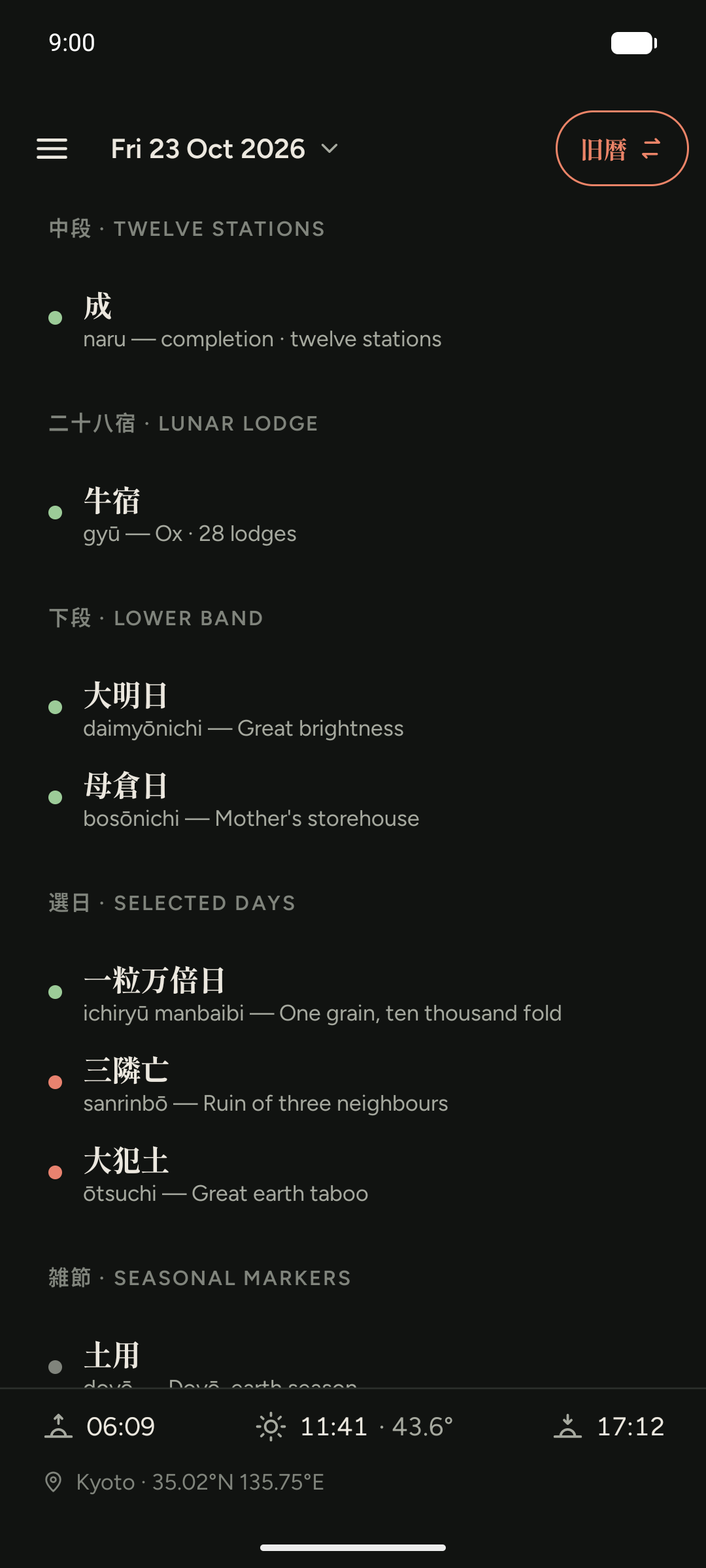
- The twelve stations (十二直, the middle band), the lunar lodge (二十八宿) and the day's 九星
- Lucky and unlucky days of the lower band (暦注下段) and the selected days (選日), such as 天赦日, 一粒万倍日, 不成就日 and 三隣亡
- Seasonal markers (雑節), festivals, the day and year signs (干支) and the lucky direction of the year (恵方)
Tap any Tibetan term or kanji to see its English. Tap an almanac line to read what it means, what it favours and what to avoid, with the published source it comes from.
Glyphs show at a glance what the day's almanac favours and warns against; dials, rings and boards in the readings show where each term stands in its cycle.
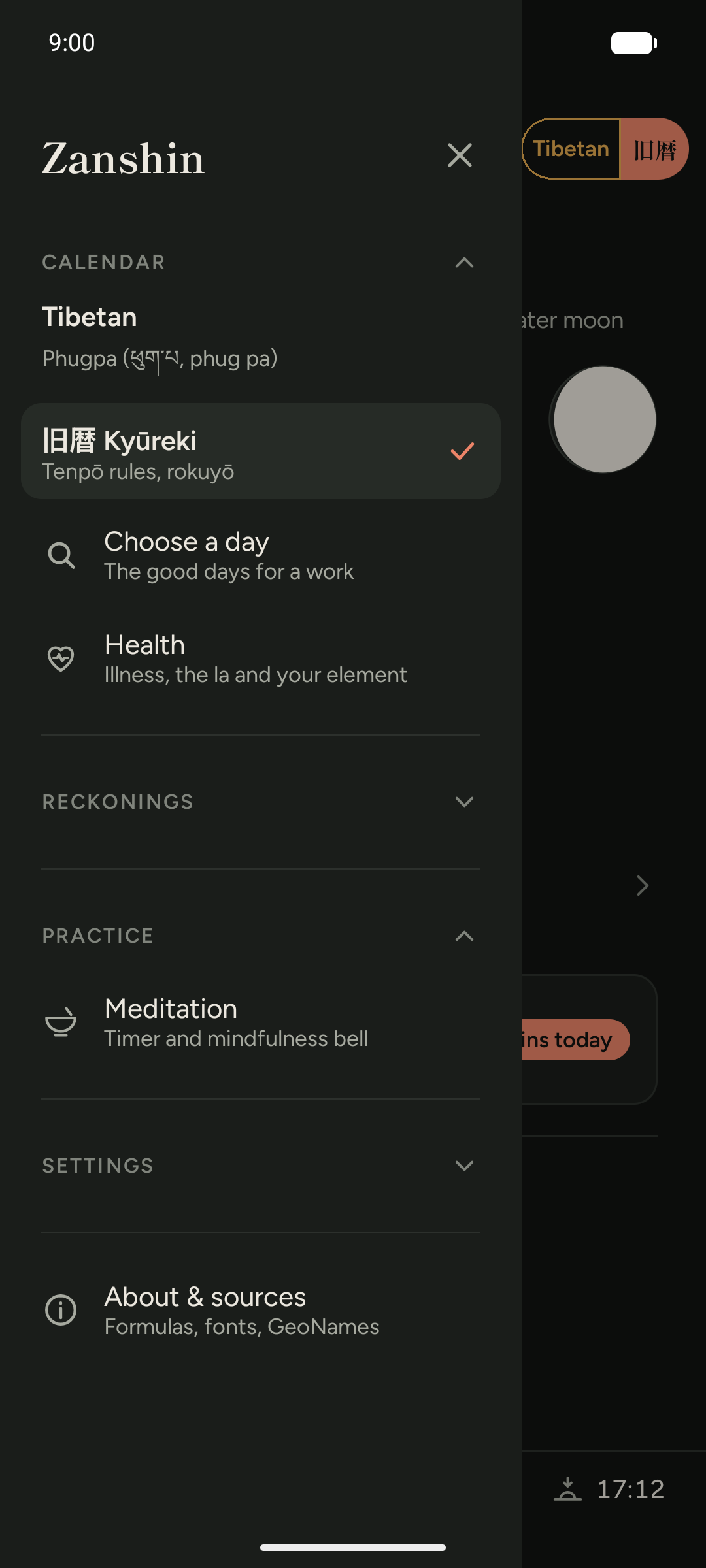
In English and Russian: choose the language in the menu, or let the app follow the phone.
Computed on the phone
Everything is calculated on the device for any date from 1900 to 2100: Tibetan dates with Svante Janson's published arithmetic, new moons and solar terms with Jean Meeus's algorithms and the VSOP87 solar theory. The results are checked against Edward Henning's Tibetan calendars and the National Astronomical Observatory of Japan.
Private
The app has no internet permission. Your location is taken once from GPS when you ask for it, picked from an offline list of cities, or typed in as coordinates, and it stays on the phone.
Give me a tip
WhatsNew:
Glyphs and diagrams: what the day is good for and what to avoid as glyphs, a day arc for the rokuyō, a ring of the solar terms, the nine stars on their board, a compass for the lucky direction, dials and rings in the readings. Tibetan terms in Tibetan script with pronunciation, the lunar mansion's reading and the day in brief, the year's four aspects, and the pebbles of your birth year by day and hour. Black days and heaven's pardon. Russian.

While you can download the APKs here directly, you should preferably use an F-Droid client so the app stays up-to-date on your device.
Packages
Version 1.1 (2026-10-05) 

Android Versions:
- Target: 17.0
- MinVer: 8.0
- ABIs: arm64-v8a, armeabi-v7a, x86, x86_64
Permissions:
Malware-Check:
Download (3.1 M)