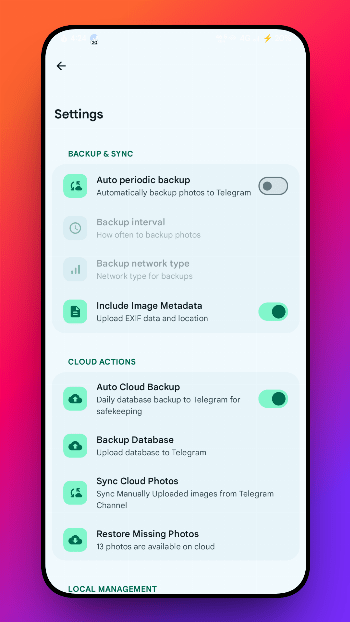
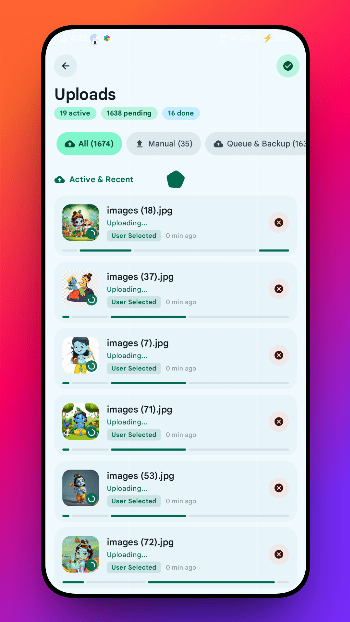
Chitralaya CloudGallery App
| Repo: | IzzyOnDroid |
| AppID: | com.akslabs.cloudgallery |
| Author: | AKS-Labs |
| License: | GPL-3.0-only |
| Donation: | Webpage |
| InRepoSince: | 2025-11-19 |
| LastRepoUpdate: | 2026-06-13 |
| LastAppUpdate: | 2026-06-13 |
| LastVersion: | 0.7 |
| Categories: | Graphics |
| APK source: | Github |
| Google Play: | Check if it's there |

Never Lose a Precious Memory Again!
Chitralaya CloudGallery (चित्रालय - "House of Images" in Sanskrit) is your personal photo fortress that transforms Telegram into unlimited, truly private cloud storage! Say goodbye to the anxiety of losing precious memories and hello to unlimited backup freedom.
🌟 Chitralaya CloudGallery is a simple open-source Android app that turns your Telegram account into a private photo cloud storage — no signup, no servers, no tracking.
Your photos go straight from your phone to your own Telegram chat, giving you free, practically unlimited backup space with full control over your data.
It’s not a company or a service — just a open-source tool made by a privacy-minded developer who believes your memories should stay yours.
I’m just another user like you, tired of the usual “cloud storage deal” — free at first, then you pay with your money... or even worse, with your privacy.
So I built something different — Chitralaya CloudGallery. It’s not a company, not a service. Just a simple, open-source tool — a bridge between your Android phone and your Telegram account.
🤔 Why even build this? I was using Google Photos like everyone else. Free storage, nice features, AI magic… but then I realized:
Google scans my photos to “offer me memories” → which also means they read them. Google uses user data to personalize services, show relevant ads, improve products,services. We users don’t even know or read what other privacy-concerning terms we’ve agreed to at the time of sign-up. And will they only use data collected from Google Photos to improve Google Photos — or does it include all Google products? Sharing a link doesn’t mean it’s private — anyone with that link can see your photos. Needs to compress images when free storage is full. One day, “free storage is full” and they said: “Pay up for more storage.” Google, builds entire business models around data.
That’s when it hit me: my photos aren’t mine. I wanted something unlimited, private, and mine. And then I looked at Telegram.
But wait… Why Telegram? Can’t Telegram see my photos?
Here’s my honest take: Telegram encrypts your data in transit, but not end-to-end (like Signal). So if they really wanted to, they could peek. But let’s be honest — so can Google, iCloud, OneDrive, or any cloud you don’t run yourself. The only way to have absolute control? Run your own server. But not everyone can afford or maintain that.
Still, it’s your call. I’m not here to sell you Telegram. I’m just here to hand you the option.
🛡️ Transparency First I don’t want you to blindly trust me either. Here’s how CloudGallery works:
Your bot token & chat ID are stored securely in Android keystore (AES encryption). Your photos go directly to your Telegram account — no middle servers. I don’t track you, I don’t log you, I don’t even know who uses this app. The app is open source. You can read the code yourself. Now, let me be fully transparent about limitations too:
Bot API has quirks → it can’t read your old messages without chat IDs. That means if you reinstall the app fresh, you won’t automatically see your past uploads. To fix that, CloudGallery keeps a local JSON database of synced images. This JSON file is also backed up to your Telegram so you can re-import it on another phone. But warning ⚠️: This database is plain text (readable JSON), not encrypted. If you leak it, others can read metadata. Keep it safe. That’s your responsibility.
⚠️ Important: The database only stores metadata and image IDs — it does not contain the actual images.
Can someone access your images with just the IDs? No, they would also need your bot token and chat ID.
I’m being this honest because I believe trust starts with showing both the strengths and the flaws.
 Anti-Features:
 NonFreeNet(this application promotes/depends a non-Free network service):
⇒ The app uses Telegram to store your images.